
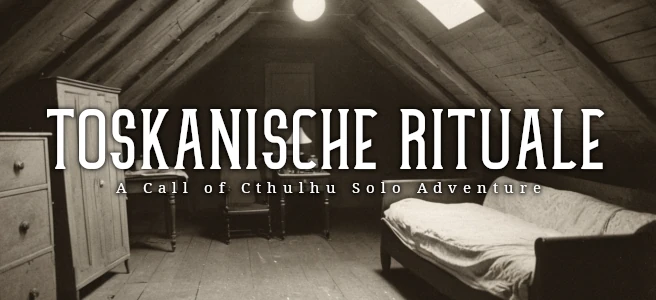
“Salve, lector.” as the educated peeps say! In the fifth part of my Call of Cthulhu solo adventure, the main protagonist uses his surroundings (i.e. the bookstore) to get some curical information and a major hit to the sanity level.
There are certain books that should not be read. Let’s see if Alfred Riemenschneider agrees with me!
Scene #13 – A trove of forbidden knowledge
The ensuing months settled into a peculiar routine within Herrn Mülder’s bookstore. I found myself diligently working alongside the professor, cataloging his vast collection of arcane texts and forgotten lore. The work was tedious but provided a welcome distraction from the unsettling reality of my situation – a desperate exile in 1915 with pursuers closing in. Evenings were dedicated to exploring the shelves myself, drawn to volumes that piqued my interest during the previous weeks’ cataloging efforts.
My reading list quickly became dominated by works of questionable repute: “Liber Ivonis”, a chilling exploration of necromantic rituals; “De Vermiis Mysteriis”, detailing grotesque marine biology and unsettling cult practices; and the German edition of “Nameless Cults”, a compendium of forgotten deities and their devoted followers. It was while immersed in the German translation, “Unaussprechliche Kulte,” that a disturbing realization struck me with unexpected force.
How could Mülder be the publisher? The book’s publication date – 1839 – predated his existence by decades. A wave of disorientation washed over me as I considered the implications. Had I stumbled into some temporal anomaly far more profound than my initial time displacement? Or was something else at play, something even more insidious?
I began to suspect that the very content of these books was subtly influencing my perception, playing tricks on my mind and blurring the lines between reality and nightmare. A growing unease settled within me; I resolved to curtail my reading of such unsettling materials, fearing their potential to further destabilize my already fragile grasp on sanity.
Yet, despite my decision to limit my exposure to these forbidden texts, a crucial piece of information solidified in my mind – a connection between my pursuers and the lore contained within those very pages. It became undeniably clear that the men who hunted me now bore a distinct resemblance to particular details described in “Unaussprechliche Kulte” and its ilk. Their movements, their lack of discernible emotion, even certain subtle physical characteristics – they echoed descriptions of cultists devoted to entities beyond human comprehension. The realization sent a fresh wave of dread through me. I wasn’t merely being hunted by shadowy agents; I was entangled in something far older, far more sinister – something that had been gestating for millennia, and now, it seemed, had finally taken notice of me.
I sought out Professor Dr. Mülder, compelled to share the unsettling connection I’d drawn between the men in dark suits pursuing me and the descriptions within the forbidden texts I’d been studying. I recounted my observations – their unnerving lack of emotion, their precise movements, even subtle physical anomalies that mirrored depictions of cultists from “Unaussprechliche Kulte” and similar works.
He regarded me with an expression that initially seemed skeptical, but quickly morphed into something far more surprising: a look of pity, tinged with a profound sadness. “You must cease reading those books,” he stated, his voice low and measured. “They will consume you entirely if you allow it. They are doorways best left unopened.”
I braced myself for dismissal, expecting him to label my concerns as the product of an overactive imagination fueled by unsettling literature. However, his response took a more nuanced turn. “While I believe your anxieties stem from exposure to these… influences,” he continued, “there is something in your account that warrants further consideration.”
He paused, gazing out at the rain-streaked window with a distant expression. “I think you should investigate those men,” he finally said, his voice barely above a whisper. “But do so with extreme caution. These are not mere mortals, and their interests extend far beyond what we can readily comprehend.” He emphasized the final words with a gravity that sent a shiver down my spine.
His unexpected encouragement ignited a renewed sense of purpose within me. The initial despair I’d felt at being stranded in 1915, hunted by unknown forces, began to recede, replaced by a grim determination. I nodded resolutely, absorbing his warning and accepting the challenge he implicitly laid before me.
“I understand,” I replied, my voice firm despite the tremor of apprehension that still lingered within. “I will proceed with caution.”
Returning to my duties in the bookstore, I felt a shift in my perspective. The mundane tasks of cataloging now seemed imbued with a new urgency. Every detail, every inscription, every obscure reference held potential significance – clues that might lead me closer to understanding the nature of my pursuers and, perhaps, finding a way to escape their grasp. The pursuit had become more than just survival; it was an investigation into something ancient, something terrifying, and I felt compelled to unravel its secrets, however perilous the journey might prove to be.
Scene #14 – The web grows
The unsettling weight of my situation demanded adaptation, and I resolved to shed the vestiges of my former life as quickly as possible. The student uniform, a constant reminder of the world I’d left behind, was sold discreetly to a wide-eyed first semester at the university for a pittance – a small price for anonymity. In its place, I acquired more appropriate attire: sturdy tweed trousers, a dark waistcoat, and a well-worn overcoat that blended seamlessly with the city’s inhabitants. To further alter my appearance, I allowed my hair to grow longer, cultivating a slightly shaggy look, and painstakingly fashioned a pointed beard using a small razor and mirror – a style popular amongst academics and intellectuals of this era. The transformation was subtle but significant; it felt like shedding one skin and donning another, designed for the shadows I now inhabited.
For the past month, my existence within Herrn Mülder’s bookstore had been punctuated by clandestine observation. Driven by his cautious encouragement, I dedicated myself to investigating the suspected cult – a shadowy organization with roots that seemed to delve into the very bedrock of history and folklore, and where my former professor, the enigmatic Dr. Bauernfeind, seemed to be a leading figure. The task was daunting; whispers and rumors were all I had to go on, fragments of information gleaned from obscure texts and overheard conversations within the bookstore’s walls.
Today, I was tasked with delivering a rare volume – a treatise on ancient Germanic runes – to a private collector. It was a mundane errand, but one that provided an opportunity to observe the city’s thoroughfares without attracting undue attention. As I navigated the bustling streets, my senses were heightened, constantly scanning for any sign of the men in dark suits – the recurring motif in my increasingly unsettling reality.
Then, it happened. Just ten meters ahead, two figures materialized from the throng – the unmistakable silhouettes of the men who haunted my dreams. They moved with a disconcerting synchronicity, their faces obscured by the shadows cast by their hats and coats. I froze momentarily, my heart hammering against my ribs.
To my shock, one of them abruptly turned his head, as if sensing my presence. Our eyes met for a fleeting instant – a split second that felt like an eternity. A wave of icy dread washed over me; it wasn’t merely recognition in his gaze, but something far more unsettling – a cold, calculating assessment, followed by a swift dismissal. He focused again on the path ahead, seemingly deciding I was insignificant, unworthy of further attention.
I resisted the urge to flee, knowing that any hasty movement would only confirm my suspicions and likely escalate their interest. Instead, I played my role – the diligent delivery person, oblivious to anything amiss. Maintaining a deliberate pace, I continued walking, carefully observing them from a discreet distance.
They proceeded down Königs Allee, disappearing into a doorway with an almost unnatural swiftness. The building bore the understated plaque of “Vincent Weidenmann, Rechtsanwalt” – lawyer and notary. It was a respectable address, seemingly innocuous, yet it now radiated an aura of unsettling secrecy. Quickly, I scribbled the address and the name onto a small piece of paper tucked within my pocket notebook – a vital clue for further investigation.
The delivery completed, I returned to the bookstore, the encounter replaying in my mind with agonizing clarity. The lawyer’s name felt significant – a carefully chosen facade perhaps? Or was it merely coincidence? Regardless, Vincent Weidenmann and his office on Königs Allee had become a focal point in my increasingly perilous investigation – a potential nexus of the cult’s activities, and a place I would undoubtedly need to revisit with extreme caution.
Scene #15 – Coming to terms
The weeks that followed proved frustrating beyond measure. Despite my best efforts, I remained ensnared within a web of obfuscation, unable to discern the true intentions of Professor Bauernfeind, the enigmatic figures in dark suits, or the lawyer Vincent Weidenmann. Each attempt to glean information felt like grasping at smoke – tantalizing glimpses that dissolved upon closer inspection, leaving behind only a lingering sense of unease and deepening frustration.
I dedicated myself to observing the movements around Weidemann’s office on Königs Allee, hoping to uncover some pattern or connection that would illuminate their activities. For several weeks, I made it my habit to loiter in the vicinity, ostensibly absorbed in reading or sketching, but in reality, meticulously cataloging every arrival and departure. The street was a hive of activity – merchants hawking their wares, students rushing between lectures, well-dressed citizens conducting business – yet amidst this bustling scene, the men in dark suits stood out like discordant notes. Their movements were precise, almost mechanical, devoid of any discernible emotion. They entered and exited Weidemann’s office with an unsettling regularity, often accompanied by individuals I could not identify – some bearing briefcases, others carrying oddly shaped packages wrapped in brown paper.
I attempted to follow them discreetly, but their skill at evasion was remarkable. They seemed to anticipate my movements, disappearing into the labyrinthine streets of Düsseldorf before I could gain a clear view of their destination. Each failed attempt only deepened my sense of isolation and reinforced the notion that I was dealing with individuals far more capable than myself.
The information gleaned from these observations proved maddeningly elusive. Sometimes, a brief exchange between Weidemann and one of the men would occur in the doorway – snippets of conversation carried away by the wind before I could decipher their meaning.
The frustration gnawed at me, threatening to overwhelm my resolve. The weight of uncertainty pressed down on me, blurring the lines between reality and paranoia. Was I chasing shadows? Had I allowed myself to become consumed by the unsettling atmosphere that permeated the Düsseldorf of 1916 since my arrival? Despite these doubts, I refused to abandon my pursuit. The men in dark suits were clearly involved in something significant – something that threatened not only my own well-being but perhaps the stability of this city and beyond. And despite the lack of progress, a grim determination fueled my continued observation, a desperate hope that one day, a crucial piece of information would emerge from the shadows, revealing the truth behind their clandestine activities.
Eighteen months had passed since I first stumbled into this bewildering reality – a span of time that felt both impossibly long and fleetingly short. The initial shock and disorientation gradually subsided, replaced by a grudging acceptance of my new circumstances. I had made my peace with the altered timeline, though the memories of my former life remained as faded echoes, haunting reminders of what was lost.
During this period, I meticulously pieced together fragments of information gleaned from countless hours of observation and study. The lore contained within those unsettling books – Liber Ivonis, De Vermiis Mysteriis, and others – combined with the patterns I observed in the movements of Bauernfeind, his associates, and Weidemann’s office, began to coalesce into a disturbing picture. It became clear that Professor Bauernfeind was engaged in a relentless pursuit: the acquisition of a specific grimoire, an ancient text rumored to contain knowledge capable of reshaping reality itself – or perhaps, unleashing something far more terrible.
The realization struck me with the force of a physical blow. The implications were staggering, and the weight of responsibility settled heavily upon my shoulders. I understood that Bauernfeind’s ambition was not merely academic; it was driven by a desire for power – a power that could have catastrophic consequences if unleashed. It became clear that I had to prevent whatever he intended to do with this grimoire, regardless of the personal risk involved.
The pieces finally clicked into place when I recalled my encounter with Bauernfeind in 1922 – his request for assistance in deciphering a particularly obscure manuscript. The memory resurfaced with startling clarity: the professor’s intense focus, the unsettling urgency in his voice, and the sudden, inexplicable disappearance of the manuscript following his untimely demise. Could it be? Was that very book the object of his relentless pursuit – the grimoire he sought to acquire at any cost?
The possibility was both terrifying and strangely empowering. Through my accumulated knowledge and observations, I had inadvertently stumbled upon a crucial piece of information: I knew when Bauernfeind would finally achieve his goal – when he would lay his icy grip on the book. The realization sent a surge of adrenaline through me, dispelling some of the despair that had been creeping in.
I understood that this knowledge was not merely an opportunity; it was a burden – a responsibility to prevent whatever horrors awaited should Bauernfeind succeed. I resolved to use this information, however vague and incomplete it might be, to thwart his plans. The task ahead would undoubtedly be perilous, but the stakes were too high to ignore. I would find a way to intervene, to disrupt his machinations, and to safeguard this timeline – even if it meant risking everything.
To be continued…
That’s it for today. I hope you liked the fifth part of “Toskanische Rituale”.
I took a little break between part five and part six and used the time to get some new books from the German edition of Call of Cthulhu. Let’s say that I found some interesting bits and pieces to help Alfred to get hold of the manuscript.
