
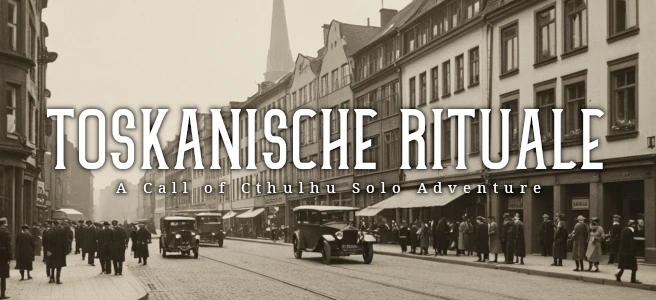
A good Fhtagn to you and welcome my solo adventure using the Call of Cthulhu 7th Edition rules and Mythic GME 2nd Edition. I was wondering why it took me so long to play CoC here as a solo project.
After playing the first few hours, I realized that Mythic GME is such a good fit for the Cthulhu mythos. If you keep your chaos factor high and your sanity low, it produces quite believable Lovecraftesque situations.
In this adventure I tried to give a focus on a city just 15 minutes away from my home which is mentioned from time to time in the works H.P. Lovecraft: Düsseldorf. Home of the publishing house of one Gottfried Mülder who published the German translation of “Nameless Cults” by Friedrich Wilhelm von Junzt and several other important books of the mythos.
So, if Düsseldorf is that important… why not let the tentacles grab some promenaders from the banks of the Rhine, relax and let’s go!?
Btw.: the title of this adventure “Toskanische Rituale” is German and means “Rituali Toscani” or “Tuscan Rituals”.
Prologue – A note from Professor Dr. Bauernfeind
The year was 1922, and I, Alfred Riemenschneider, found myself embroiled in a situation far exceeding the scope of my studies at the University of Düsseldorf. At twenty-three years of age, I was pursuing a degree in psychology, a field that seemed increasingly inadequate to explain the unsettling events which would soon consume me. Born and raised within the confines of Düsseldorf, I carried the weight of my lineage – my father being Karl August Riemenschneider, a man whose considerable wealth stemmed from the city’s burgeoning industrial sector. Furthermore, I was a member of Teutonia Libertas, a dueling student fraternity known for its rigorous traditions and, perhaps more importantly in this instance, its network of influential individuals throughout the Rhineland. It provided a certain… protection, though I doubted it would prove sufficient against what lay ahead.
It began innocently enough, or so it appeared at the time. Professor Dr. Ernst Bauernfeind, a man known for his eccentricities and unsettlingly intense gaze, summoned me to the university library. The summons itself was unusual; Bauernfeind rarely sought assistance from undergraduates, particularly not in matters outside of established academic channels. I recall receiving the message via a rather terse note delivered by a nervous-looking student – “Urgent. Library. Do not delay.” Naturally, curiosity and a sense of obligation compelled me to attend. The library itself was a labyrinthine structure, filled with the scent of aged paper and a pervasive stillness that seemed to absorb all sound. I found Bauernfeind hunched over a particularly large volume in a secluded alcove, his face illuminated by the weak light filtering through the tall, arched windows.
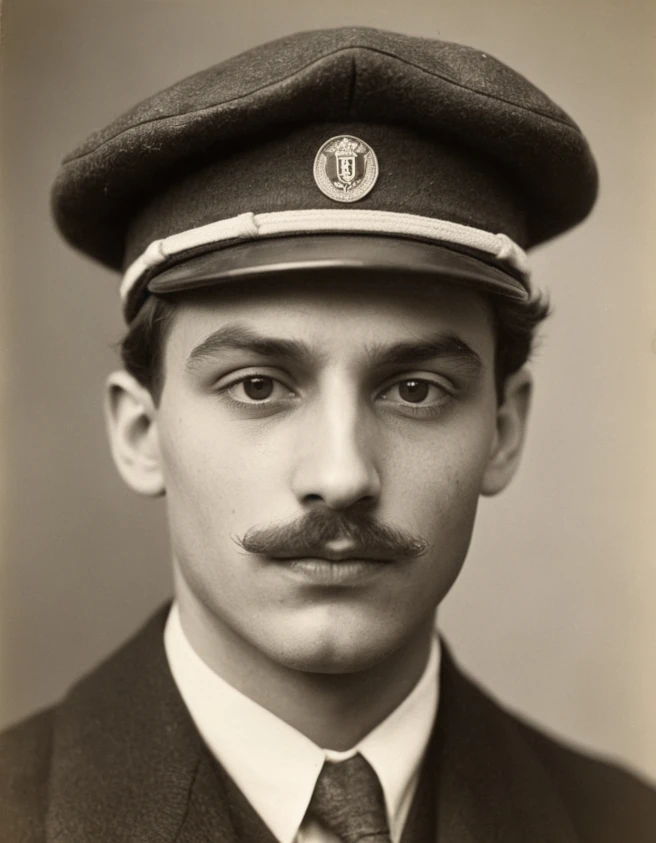
“Riemenschneider,” he said without looking up, his voice raspy and strained. “You are here precisely when I require you.” He finally raised his gaze, and I noticed a peculiar tremor in his hands as he gestured towards the book. “I have encountered… a matter of considerable complexity,” he continued, his words carefully chosen. “A matter that requires a certain… psychological perspective. Something beyond the realm of conventional scholarship.” He paused, then added with an unsettling intensity, “It concerns a manuscript, recovered from a rather obscure source. Its contents… disturbs me greatly. I believe your rather clumsily hidden understanding of the… occult may be instrumental in deciphering its implications.” The volume he indicated was bound in dark, unmarked leather, and it emanated a palpable sense of wrongness – a subtle distortion of the air around it that sent a shiver down my spine.
Scene #1 – An unspeakable manuscript
Standing beside Professor Bauernfeind, I leaned closer to examine the manuscript. The script appeared to be Latin, yet it bore little resemblance to the forms familiar from my studies or even the ecclesiastical Latin employed by traditional scholars. It was an archaic tongue, twisted and unfamiliar, hinting at a lineage far older than any documented history. Attempting to parse its meaning proved frustrating; I could only grasp fragments – isolated words that seemed to shimmer with a disturbing resonance. “…nox… profundis… sub…” I murmured, the syllables catching in my throat. The phrases refused to coalesce into coherent sentences, leaving me adrift in a sea of unsettling linguistic debris. It was as if the language itself resisted comprehension, guarding its secrets jealously.
“Professor,” I began, attempting to politely extricate myself from the situation, “with all due respect, this task… it exceeds my capabilities entirely. My understanding of linguistics is rudimentary at best, and this language…” I trailed off, gesturing towards the unsettling manuscript. “I believe I must decline your request.”
Before I could fully retreat, Bauernfeind’s grip tightened on my arm with surprising strength. His face was a mask of earnest pleading, etched with lines of exhaustion and something akin to desperation. “Please, Riemenschneider,” he implored, his voice barely above a whisper. “Just one more look. You possess an… intuition that I lack. See if you can glean anything.”
Reluctantly, I returned my gaze to the page. This time, focusing intently, I managed to decipher something beyond isolated fragments. Scrawled in a disturbingly vibrant dark red ink across the top of the first page was a title: “Othuum Omnicia.” The words themselves felt… wrong, vibrating with an unsettling energy. Below it, however, there was no author’s name, no publisher’s mark – nothing to indicate provenance or origin. The absence of any imprint suggested either extreme antiquity or, perhaps more disturbingly, that this was the sole existing copy of this text, a private and unshared revelation. A flicker of something akin to curiosity, despite my apprehension, began to stir within me. The unsettling nature of it all, combined with the sheer uniqueness implied by its lack of publication, proved unexpectedly alluring. My initial reluctance began to fade, replaced by a nascent, uneasy interest.
Bauernfeind’s eyes gleamed with a disconcerting intensity as he observed my gaze tracing across the pages of “Othuum Omnicia.” A slow nod confirmed his hopes, a silent acknowledgment that I was beginning to penetrate the veil of archaic language. From then on, an uneasy collaboration began. Periodically, I would stumble upon a phrase or fragment that momentarily resolved itself in my mind, and I would read it aloud – haltingly, with considerable effort – while Bauernfeind meticulously transcribed the words into his worn leather-bound notebook.
“I have managed to decipher certain passages myself,” he admitted quietly, gesturing towards his own notes. “Though they are… fragmented, incomplete.” His voice held a tremor of anxiety, as if even acknowledging the partial translations felt perilous. I hesitated before speaking, then recalled a fleeting memory from my earlier studies. “Professor,” I began cautiously, “I believe I once encountered something similar – a book that explored comparable themes.” A brief pause followed as I wrestled with the recollection. “It was an Italian work, of unknown authorship, titled ‘Rituali Toscani’ – Tuscan Rituals.”
I continued, “The text was translated into German and published as ‘Toscanische Rituale’ by Professor Dr. Hermann Mülder, a publisher here in Düsseldorf. He specializes in collecting and disseminating… esoteric literature.” The mention of Mülder felt oddly significant, as if the threads of this unsettling situation were beginning to weave themselves together in ways I didn’t yet understand.
Bauernfeind’s nod was now frantic, almost convulsive, his eyes burning with a feverish light. “You must acquire this book,” he urged, his voice barely controlled. “‘Toskanische Rituale.’ Find it, Riemenschneider! And meet me tomorrow evening at my apartment on Bolkerstraße – precisely at twenty o’clock.” The urgency in his request was unsettling, yet I found myself agreeing without much deliberation. A strange compulsion seemed to override any rational objections; the allure of the unknown, coupled with Bauernfeind’s palpable desperation, had somehow swayed my judgment. Even as the words left my lips, a nagging sense of unease settled within me – why was I so readily drawn into this disturbing affair?
Bidding farewell to the professor felt like stepping out of a dream and back into a harsher reality. Leaving the library, I emerged into a night that seemed unusually dark and cold. The cobblestone streets were slick with moisture, reflecting the meager gaslight in distorted patterns. My mind replayed the images from the manuscript – the unsettling script, the title “Othuum Omnicia,” Bauernfeind’s frantic demeanor. The thought of both books – “Othuum Omnicia” and “Toskanische Rituale” – haunted me as I made my way home.
Scene #2 – In Memoriam
The following morning, I returned to the university with a sense of anticipation mingled with apprehension. However, what greeted me was far more unsettling than anything I could have imagined. A sizable crowd had gathered at the entrance of the library building, their murmurs and hushed tones creating an atmosphere thick with unease. Pushing my way through the throng, I recognized Axel Härig, a close friend and the vice president of Teutonia Libertas. His face was pale, etched with a mixture of shock and disbelief.
“Alfred! Have you heard?” he asked, his voice strained. “It’s Bauernfeind… they found him dead in the library.” The news struck me like a physical blow. “A heart attack, apparently,” Axel continued, though his tone lacked conviction. “The constable says there were no visible injuries; foul play has been ruled out.” I stared at him, unable to fully process what he was saying. It felt impossible – Bauernfeind, dead?
Shaken and disoriented, I left Axel behind, navigating further through the crowd until I reached the library entrance. A large constable, his face impassive, blocked access. He offered a curt nod in my direction, but said nothing as I stood there, staring at the imposing building – now a scene of quiet tragedy and unsettling mystery.
The constable’s refusal to grant entry only fueled my growing unease. “Excuse me,” I asserted, attempting a semblance of composure despite the turmoil within, “I am Alfred Riemenschneider, and I was assisting Professor Dr. Bauernfeind with research. We had a meeting here last night, in this very library.” The constable remained unmoved, his expression stoic. Just as I braced myself for further resistance, he abruptly turned to his colleague, exchanged a few words, and then, surprisingly, gestured towards the interior. “Take him to Inspektor Rosenbaum,” he ordered curtly.
Squeezing between both officers, I entered the library’s hallowed halls, each step echoing unnaturally loud in the sudden silence. The scene that awaited me was far more disturbing than any description could convey. Professor Dr. Bauernfeind lay sprawled on the floor precisely where I had left him the previous evening. His face was a ghastly white, his eyes wide and fixed in a silent scream, his mouth agape as if frozen mid-utterance. It was a tableau of sudden, inexplicable horror.
Approaching cautiously, I introduced myself to the man I assumed was Inspektor Rosenbaum, a stern-looking individual with sharp features and an air of weary authority. “I am Alfred Riemenschneider,” I stated, my voice trembling slightly. “I met with Professor Bauernfeind last night. He appeared perfectly well when I departed.” As I spoke, my gaze involuntarily wandered across the scene, taking in every detail. And then I saw it – a glaring absence amidst the chaos: the manuscript. “Othuum Omnicia,” the book we had examined together just hours before, was gone. The space where it lay open on the table now held only dust and shadows.
“Has the manuscript been taken?” I blurted out, gesturing towards the empty space on the desk where “Othuum Omnicia” should have been. “Perhaps a staff member secured it?”
Inspektor Rosenbaum barely glanced at the spot, his attention already consumed by the unfolding investigation. “There was nothing on the desk when we arrived,” he stated matter-of-factly, dismissing my concern with an air of professional detachment. He seemed more interested in minimizing paperwork than delving into the details. The lack of further inquiry felt almost negligent, a missed opportunity for crucial insight.
The realization struck me with chilling certainty: someone had taken the book after Professor Bauernfeind’s death. But who? And what role did it play in his demise? The constable’s dismissal of foul play now seemed increasingly dubious. Was this truly a tragic accident – a sudden heart attack – or was there something far more sinister at work, something connected to that unsettling manuscript and its cryptic contents?
The questions swirled within me, demanding answers I didn’t possess. Unable to bear the oppressive atmosphere any longer, I quickly retreated from the library, squeezing past the officers guarding the entrance and finding myself back in front of the building. The scene before me – the throng of onlookers, the solemn police presence – felt like a stage set for a tragedy whose full extent remained tragically unknown.
Scene #3 – Frau Ellenore Pollmächer
As if guided by an unseen force, I walked along the southern edge of the library building, a trance-like state gripping me. The notion of Professor Bauernfeind’s death being attributed to a simple heart attack felt utterly preposterous – a convenient explanation designed to mask something far more sinister. I scanned every inch of the ground, every shadow and crevice, desperately seeking any clue that might illuminate what had transpired. The cold air seemed to press in on me, amplifying the unsettling silence broken only by the rustling of dry leaves underfoot.
After a while, my persistence paid off. Something felt… off. A subtle disturbance amidst the otherwise uniform landscape caught my eye. Pushing aside a tangle of overgrown branches, I discovered it: a silver cigarette case lying half-hidden in the bushes beneath one of the library’s windows. It was an object of exquisite craftsmanship, adorned with intricate Art Nouveau decorations – swirling floral patterns and graceful curves that spoke of wealth and refinement. But what truly arrested my attention were the initials etched into the front, nestled beside the decorative flourishes: A.R.
The discovery sent a jolt through me, a spark of hope amidst the growing despair. This was tangible evidence – something beyond conjecture or speculation. It suggested someone else had been here, someone who perhaps knew more than they let on. The cigarette case felt heavy in my hand as I instinctively stuffed it into the pocket of my coat.
Turning abruptly, I stumbled away from the building, abandoning any pretense of composure. The weight of the silver object pressed against my thigh, a constant reminder of the unsettling mystery that now enveloped me – and the growing suspicion that Professor Bauernfeind’s death was far more than it appeared to be. The library loomed behind me, a silent monolith guarding its secrets, while I hurried into the gathering dusk, carrying a piece of the puzzle and a burgeoning sense of dread.
A wave of icy dread washed over me, so potent it nearly knocked me off my feet. The implications of my actions slammed into me with brutal force: what if the person or group responsible for Professor Bauernfeind’s death had observed me leaving the library last night? Or even worse, what if they overheard my brief exchange with the constable, revealing that I worked alongside the professor? The realization sent a fresh surge of panic through me. I felt utterly exposed, vulnerable – a pawn in a game far beyond my comprehension.
The need for immediate action became paramount. I had to take countermeasures, to vanish from sight before they realized I possessed something – the cigarette case, and perhaps more – that could lead them back to the truth. My plan formed quickly: a short visit to my apartment on Dorotheen Straße to gather essential supplies, followed by an extended disappearance into anonymity. The fraternity club was out of the question; its members were too easily tracked, too readily connected to me. And my parents’ home? That would be far too obvious, a beacon for anyone seeking to find me.
Boarding a tram heading east through Düsseldorf, I began formulating a strategy. My mind raced as the city blurred past the window – a kaleidoscope of brick buildings and flickering gaslights. Ellenore Pollmächer presented herself as the most viable option. A woman of forty-two years, she possessed an air of quiet resilience and a generosity that extended beyond mere kindness. I knew her from the Tanzcafé Bellevue, where I occasionally worked as a… gentleman companion – a discreet arrangement that afforded me a degree of anonymity. She would undoubtedly be willing to offer sanctuary, to let me stay for a few nights without asking too many questions. It was a risky proposition, but it offered the best chance of evading whatever shadows now pursued me. The tram rattled onward.
To be continued…
Jup, I know… I had the map of Düsseldorf in 1920 at hand, used historical references and still talked about a university that will be opened in 40 years time. But I was in such a desperate need of a university in Düsseldorf.
Nevertheless, I hope you liked the beginning of this adventure and hope to see you next week for part two.
